
Clearing Redundant Process Means More Homes in Seattle
A bill before Seattle City Council next week would remove a redundant appeals step that almost never changes a decision but routinely delays new housing for months.
On July 1, the City Council’s Land Use Committee holds a public hearing on a bill that sounds like pure bureaucracy and is actually one of the more meaningful housing moves of the year. It comes from Councilmember Eddie Lin, who chairs the committee. It does something simple: it removes a step in Seattle’s process that the state already decided was unnecessary, and that, in practice, does little except delay.
We care about the gap between what city government promises on housing and what it actually delivers. This is one of those places where process is part of the gap, and a clean example of what we stand for: city government keeping its own promises and clearing away friction that blocks homes for our neighbors, without giving up any real protection. So we want to explain it in plain English.
First, what is SEPA?
SEPA is the State Environmental Policy Act, a Washington law from the early 1970s. In short, it requires governments to study the environmental effects of a decision before they make it, and to give the public a chance to weigh in. It is a good idea, and most of the time it works fine. The trouble is that it has been stretched well beyond its original purpose, to the point that the owners of an existing condo tower can use SEPA to hold up a new housing project that would block their views.
The extra step
When Seattle changes its zoning, or updates its Comprehensive Plan (the long-range blueprint for where homes, jobs, and parks go), that change comes with an environmental review. Under Seattle’s own code, the review can be appealed to the city’s Hearing Examiner, an independent official who rules on challenges to city decisions. While that appeal is heard, the change is on hold.
Here is the catch. The State Legislature has spent the last several years deciding that adding homes in already-built, transit-rich neighborhoods is itself good for the environment, and it passed laws in 2022 and 2023 exempting those housing decisions from exactly this kind of appeal. As the state senator who wrote one of those laws put it, environmental rules were too often being “weaponized against pro-environmental, pro-housing ways forward.”
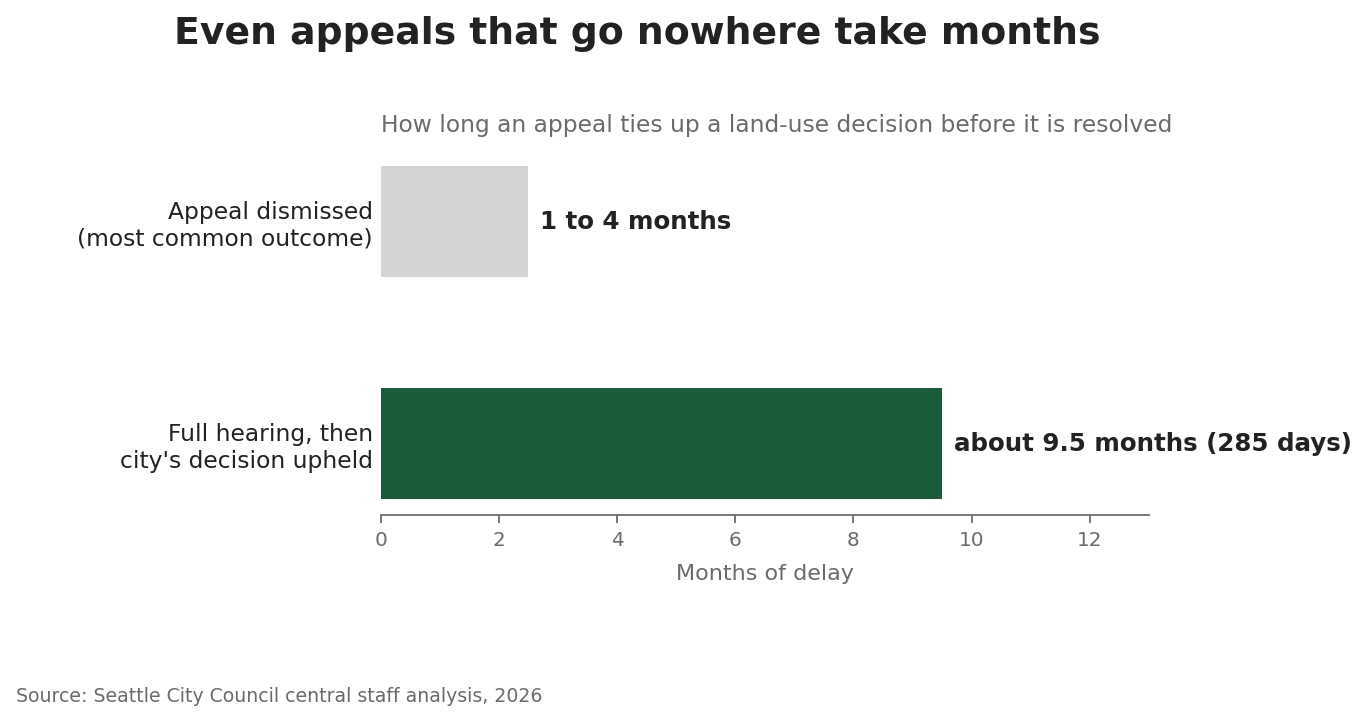
So many of these appeals are already destined to fail. Where the new state law applies, the Hearing Examiner has to dismiss them. But even a required dismissal takes months, and the clock runs the entire time. Real housing projects get stopped this way, or never even begin.
What the data actually shows
You don’t have to take our word for it. The Council’s own staff looked back at the last ten years. There were about 25 of these appeals, brought by roughly 64 people. Most were dismissed, often because the law no longer allowed them at all, and even that took one to four months. The rest got a full hearing on the merits, and the city’s decision was almost always upheld anyway, after an average of about 285 days, more than nine months. In a full decade, only two ever changed the outcome.
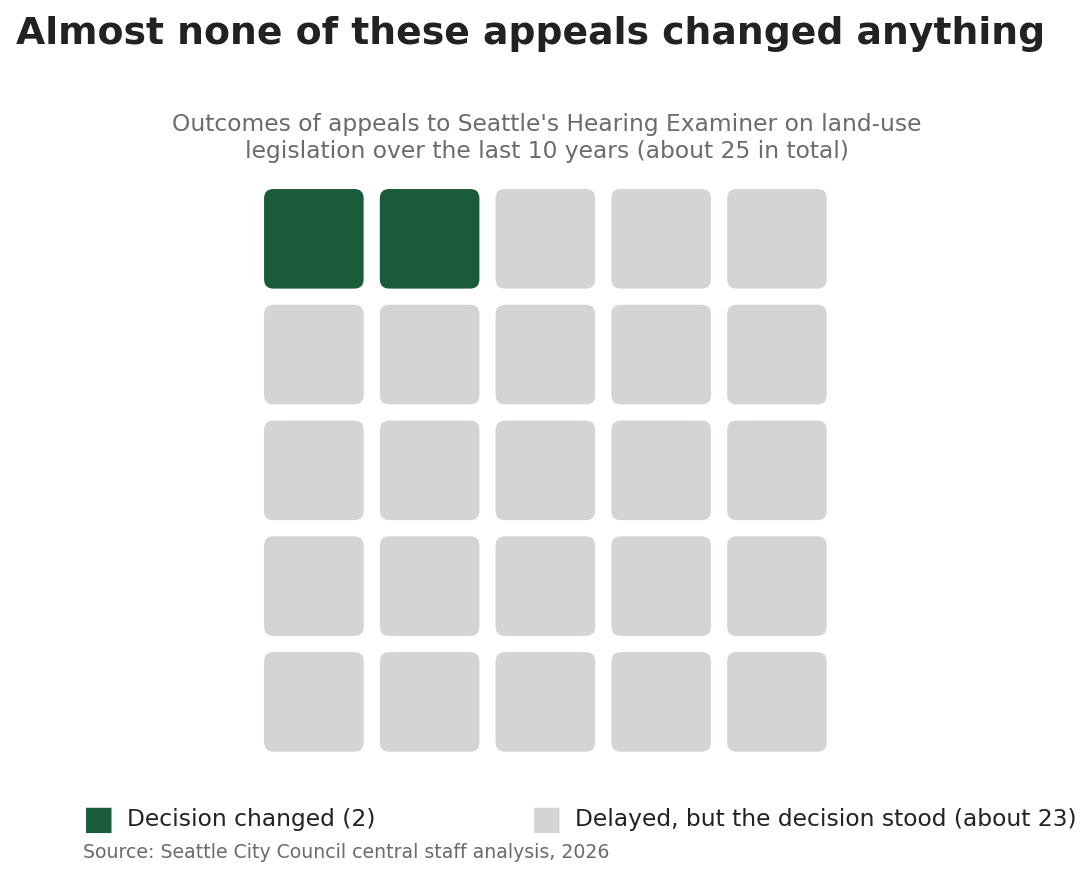
Read that again: a process used, over and over, to delay decisions by months, that almost never changes the decision.
Who benefits from endless process
There is a deeper point here, and the bill’s sponsor has made it clear: process is not free, and it is not neutral. Two things happen when a decision can be studied, appealed, and sent back for round after round of comment. First, there are diminishing returns: asking the same question a seventh or eighth time rarely surfaces anything new, it mostly rewards whoever has the stamina to keep answering. Second, the people who keep showing up tend to be the same handful of the most organized and persistent voices. The renter working two jobs, the family already priced out to the suburbs, the young person who cannot make a Tuesday afternoon hearing: those are exactly the people a never-ending process leaves out, even though they have the most at stake. And delay is itself a decision. Choosing to wait is choosing the status quo, and in a city that is not building enough homes, the status quo has real costs for real people (including but not limited to higher rents).
What Lin’s bill does, and what it doesn’t
Lin’s bill removes the Hearing Examiner step for these specific land use decisions, and points appeals to where state law already sends them: King County Superior Court, or the state Growth Management Hearings Board (a panel created specifically to hear challenges to growth plans).
We should also be clear about what the bill does not do. It does not remove a single environmental protection. Our critical areas ordinance, stormwater rules, tree regulations, and mitigation requirements all stay exactly as they are. The bill does not authorize cutting anything down. It does not take away anyone’s right to challenge a genuinely bad decision in court. It removes one local detour that the state already closed everywhere else in Washington.
A lot of the opposition to this bill comes from neighbors who love Seattle’s tree canopy. We love it too, and we take those concerns seriously. So here is the bigger picture: the single most powerful thing a city can do for the environment is build homes inside the compact, transit-rich places we already have, so that growth doesn’t get pushed outward into forests and farmland where whole ecosystems get cleared. A dense city and a green, livable, tree-filled city are not opposites. Taking the pressure off sprawl is itself an act of conservation. That is a longer conversation and it deserves its own piece. For now, the narrow point holds on its own: an appeal that almost always loses should not be able to freeze a good decision for nine months.
Why this matters right now
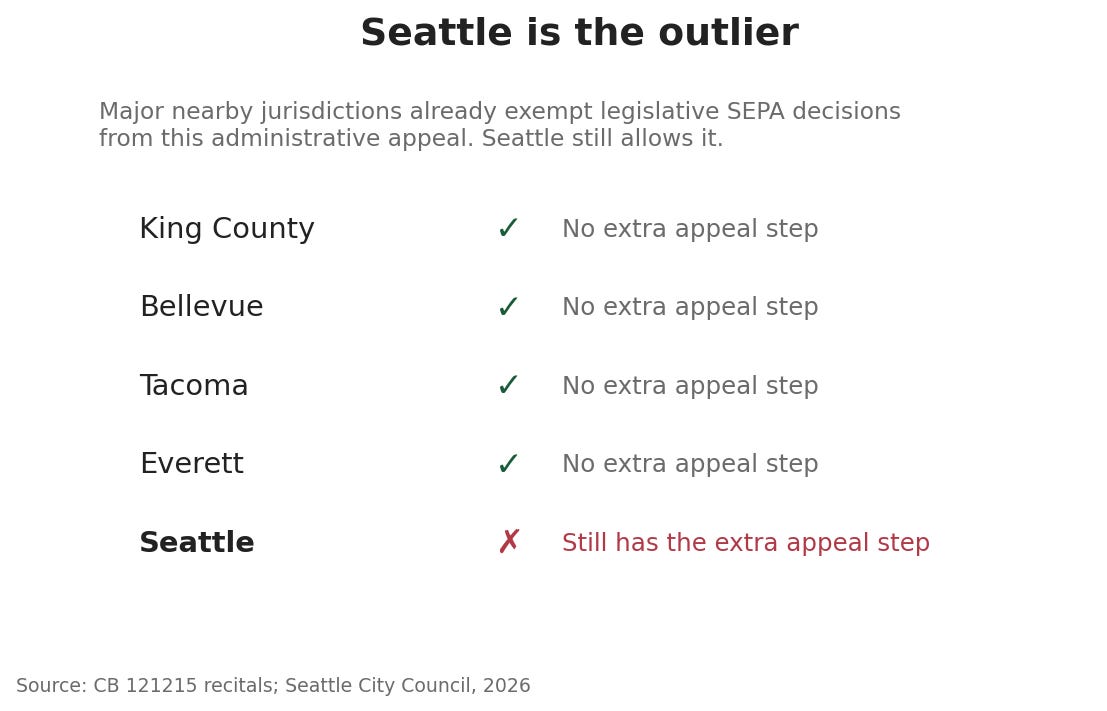
This is not happening in a vacuum. Mayor Wilson’s administration is about to restart environmental review for the next phase of Seattle’s growth plan, the one being called “Taller Denser Faster.” A review process that can be frozen for the better part of a year by an appeal that is destined to lose is exactly the kind of thing that has knocked Seattle’s big housing plans off schedule before. And Seattle would not be doing anything unusual here. Most of our neighbors already work this way: King County, Bellevue, Tacoma, and Everett all handle these appeals without this extra local step Seattle has kept. Fixing this now is laying the track before the train arrives.
Why we’re weighing in
This isn’t For Seattle’s flagship campaign, and we’re glad others are carrying the bigger housing fights alongside us. We’re weighing in anyway, because where an organization chooses to plant its flag on the minutiae tells you what it actually values.
What you can do
The public hearing is July 1. If you want Seattle to be a city that can actually build the homes it keeps promising, here are three things you can do.
Show up on July 1. The Land Use Committee hearing is at City Hall, in person and virtually, 9:30AM on July 1. Shoot us a quick email if you want to join some of our members that day, and here is info on how to give virtual testimony if you can’t make it in person. Tell the committee you support bringing Seattle’s appeals process in line with state law.
Send a note to the Council. The fastest way is the Complete Communities Coalition’s one-click tool, which delivers a message to the full Council in about a minute (personalizing it helps it resonate). Prefer to write your own? Email council@seattle.gov; one or two sentences is plenty, and the point is simple: this is common-sense alignment, not a loss of protection. Not sure what to say? Here is a sample you can copy and adapt:
Dear Seattle City Councilmembers,
I support Chair Lin’s legislation to bring Seattle’s SEPA process in line with state law. Seattle needs strong environmental protections, but SEPA should not be used as a repetitive delay tactic to block needed housing. Please support a clearer, fairer process that protects the environment while allowing our city to build the housing we urgently need.
Subscribe below, and consider joining us. We’ll keep tracking this and the larger growth-plan work as it unfolds. You can also find us on X and Bluesky. And if you have time, skill, or relationships to bring to this work, reply and we’ll be in touch.
Washington wrote the smarter rule years ago. This is just Seattle catching up to it. Let’s get it done.
This statement is factually incorrect. Please edit for accuracy "It removes one local detour that the state already closed everywhere else in Washington." The director's report that you have sourced your list from has a column right next to it of some cities and counties that still have a pre-decisional hearing examiner process.
Olympia, Spokane, Snohomish and many other municipalities across the state still use this predecisional process which is allowed by the state legislature, as David Mann in the court of appeals Division 1 said the legislature knows how to amend their statutes and if they meant to take it away they would have. You can look that up from the March 4th Court of Appeals division 1 recording on TVW.